

This is a non-commercial site. The information contained in this site has been collected from several sources and its accuracy cannot be guaranteed. No copyright has been intentionally violated. If you feel a copyright has been violated please contact me immediately and the material will be removed
DBTune hosts a number of servers, providing access to music-related structured data, in a Linked Data fashion. All the services hosted here are based on open Web standards such as RDF and SPARQL.
This effort is part of the Linking Open Data on the Semantic Web community project, hosted by the Semantic Web Education and Outreach interest group.
November 2017 update: This server has recently been revived at the Centre for Digital Music following a period of downtime. Many of the datasets have been restored, mostly using a default ClioPatria server viewing static data (i.e. datasets that were originally dynamic are now old static snapshots). Some datasets have been officially retired. More details are below.
Resources on the Web can be far more than web pages. They can identify anything: me, a French band, an audio signal, etc.
Such resources have associated representations (accessed, in our case, through HTTP), which may be either human-readable (an XHTML document, for example) or machine-processable (Microformats or RDF). These representations may hold links to further resources, allowing to jump from one resource to another, which may be actually hosted in different places. This is were the Web aspect comes into place.
Let's take an example. The resource http://dbtune.org/jamendo/artist/5 identifies a French band, called Both. Asking for a RDF representation of this resource gives us back the following statement:
<http://dbtune.org/jamendo/artist/5> <http://xmlns.com/foaf/0.1/based_near> <http://sws.geonames.org/2991627/>We can then follow this link to get to a resource identifying a geographic location, located within the dataset. Moreover, this link is also a resource identifier! So if we don't know what it means to be based_near something, we can still access a representation of it, which would give us statements such as "based_near is a property, and it relates a person or a group of person to a geographical location".
The following datasets are available on this server:
The following datasets used to be available on this server but are no longer provided, in most cases because the third-party APIs backing them no longer exist. The descriptive pages are retained for historical interest.
The datasets originally available on this server, as well as their interlinks, correspond to the blue circles in the following diagram.
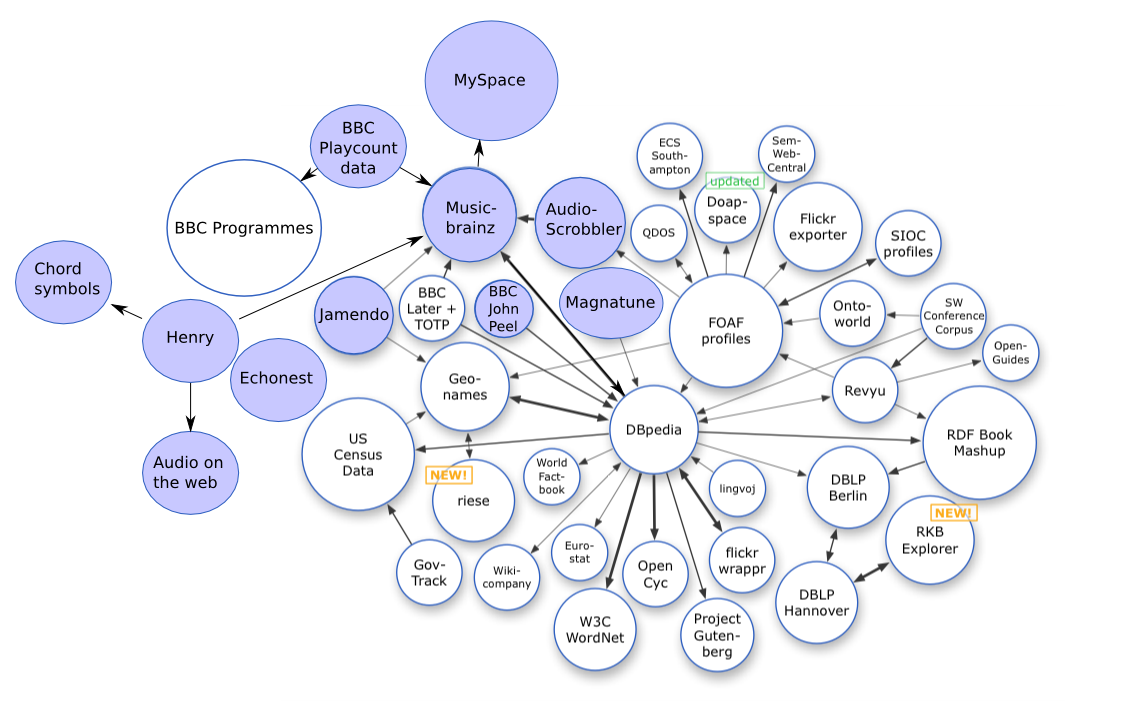
Original diagram from Richard Cyganiak under the CC-BY-SA license.
The following dataset interlinking have been achieved:
All the things provided by this server relies on the work of many people. Let's try to mention a few:
